The song: Scottish singer-songwriter Archie Fisher (1937-2025) wrote “Dark-Eyed Molly” for his fourth album THE MAN WITH A RHYME (Folk-Legacy label, 1976). He wrote, “The compatibility of unrequited love and strong drink has been the theme of many a traditional song. Speaking from experience, it doesn’t help in the long run, but think of the songs we’d miss without the experiment. The melody is that of a Basque lullaby and the words are my reconstruction from a line or two of Gaelic poetry.” Two years later, Canadian folk musician Stan Rogers included the song on his album TURNAROUND. The British group Fairport Convention recorded it in 1988, and presumably consulted with Fisher when they wrote in the album notes, “The words are an approximate translation of a traditional Gaelic song. The tune was lost several years ago. Archie [Fisher] learnt the tune as an instrumental in the 20’s from a guitarist called Johnny Saturday. Archie’s mother said it was very similar to the original she remembered and so the marriage was made.”
Eva first heard “Dark Eyed Molly” when Fairport Convention performed it at the Birchmere in Alexandria, Virginia. Chris Biondo remembers, “Eva and I went with Eva’s parents, her brother Dan, and Larry Melton. Dan knew the violin player, came up and talked to him after the show. They did that song. Eva started playing it live, did it a few times.”
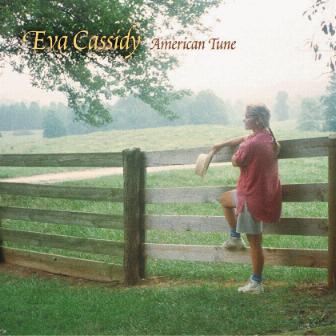
Marcy Marxer (center) with Cathy Fink (left) and Grace Griffith (right). Photo by GerryThe recording: Eva’s “Dark-Eyed Molly” was released on the album AMERICAN TUNE in 2003. Like many of the tracks on this album, “Dark-Eyed Molly” was fortuitously preserved by Keith in a box of rehearsal cassettes that had been long packed away (see this article for more details). The song was taped in the studio, with Eva’s vocals and acoustic guitar, supplemented by Keith Grimes’s electric guitar improvised as they went through the song together.
For the 2003 album, additional instrumentation was added by the multitalented Marcy Marxer — including tin whistle and bouzouki (Marcy quips, “When I take it through airport security, I call it a mandolin”).
Marcy told me she had a lot of fun working on the song, and said “The vocals are amazing!” Eva and Marcy Marxer had met a few times through the local music scene. “I didn’t get to spend time with her until she was ill. We had planned to get together when Cathy and I got back from a [1996] tour in Japan. She was ill when we got back.” But she was able to visit, and Eva’s mother Barbara loves to tell about how Marcy and Grace Griffith gave Eva great joy in her last weeks, by singing harmonies with her. (What a precious gift of support and friendship!)
“Dark-Eyed Molly” turned out to be quite a project, much more in-depth than merely adding instrumental tracks. Nowadays, as Marcy notes, much of the work needed to bring “Dark-Eyed Molly” to completion might be achieved through “A.I.,” but I am skeptical it would be as good. Marcy wrote about the process for the Eva Cassidy Fan Club website, and with her permission and that of the webmaster, I attach those recollections here for the special enjoyment of audiophiles and engineers and musicians who revel in such details:
“When Blix Street Records started running out of material they started looking at rehearsal tapes. Artists all over the Washington, DC area started donating to the cause. Bill Straw (president of Blix Street Records) gave me a cassette of Eva making a practice tape for a tune called ‘Dark Eyed Molly’. It was really meant as a rough tape so the band could learn the song.
The heads on the cassette were out of alignment and there was a terribly loud ground hum. Eva had a mic for singing on one track and the other track was the pickup from her acoustic guitar plugged directly into the cassette machine. There is an electric guitar player in the background playing along that is heard on the vocal track. The song arrangement Eva was playing had different chord changes for every verse but the guitar player didn’t know that in advance so he’s making quite a few mistakes not realizing he was being recorded. It would have been next to impossible for a player to follow along with no chart and not make mistakes.
The tape had a beautiful vocal on it but otherwise it was a real mess. I took it to two of the best engineers in town, Greg Lukens and Bill Wolf, who were able to align the heads and roll off some of the bottom of the ground hum.
Then I took the track home to my studio and recorded the 2 tracks 11 times so all of my 24 tracks were full. I turned the EQ faders down on every track to eliminate as much sound as possible. Then I listened to each individual track to find a frequency that came from only Eva’s voice. That process left me with 24 strong tracks of frequencies from Eva’s voice. It also had the effect of turning the things that were not coming from Eva’s voice down until her voice sat well above the other noises.
Then I used left and right panning knobs to get the audio image of her voice right. Frequencies that sounded like her nose went in the middle, sounds that came off her cheek bones were panned to the sides, etc. It took a long time but I’ll never forget the moment when the audio image finally popped in front of me. I had my eyes closed with headphones on and her voice sounded like it was surrounding me. The entire process to that point took about two weeks. I kept working in one direction and when it wasn’t right I would start over.
Marcy Marxer (left), with Lenny Williams, Grace Griffith, and Chris BiondoThen it was time to put instruments on the track. I tried to match Eva’s guitar strumming exactly as she had played it. I couldn’t use her guitar because of the hum and poor recording. Then I filled out the song with instruments I knew she liked, 6 and 12 string acoustics recorded in lush stereo, bouzouki. There was still some distant electric guitar playing. Some of it was good so I kept as much of it as possible. I added tin whistle to cover up the mistakes in some places.
The whole process including adding instruments took about 3 weeks. I didn’t do any punching in and there was no click track. I played the entire tune over and over learning the small pauses, then played the whole pass to make it sound natural. The process that I developed opened a way to work with the old cassette tapes and I learned a lot in the process. There are computer programs that will do a lot of that work now. It would be much easier these days!
I did a final mix that I thought Eva would love and sent it to the record company. It was the best I could do. Bill Straw remixed it for the American Tune album and added some of the ground hum back in. He likes a dirtier sound and wanted it to sound less polished. Now listeners can hear some of the electric guitar mistakes, too. It’s a matter of personal preference, really.”